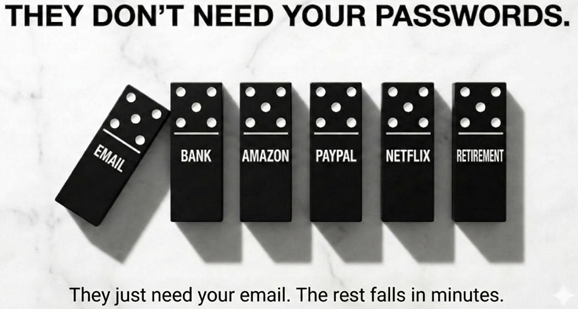
| Think about what lives in yours. |
| Bank statements. Doctor results. Your retirement account, your mortgage company, every streaming service, every store you’ve ever bought anything from. And every single password reset link on the planet lands right there. |
| A criminal doesn’t need to hack your bank. They just need your inbox. One account. Every other door swings wide open. That’s not a flaw. That’s how email was designed to work. And most people protect it with the same password they’ve used for years and years. |
| Nope. Not anymore. |
| 🔑 Here’s how fast it happens |
| Hackers go to your bank’s website. Click “Forgot Password.” Type your email. The bank sends a reset link straight to your inbox. The criminal, already inside, clicks it, creates a new password and walks right in. Then they do it to your Amazon. Your PayPal. Your brokerage. Each one takes about 60 seconds. It’s less effort than ordering a pizza. |
| The FBI calls this account takeover fraud. And 81% of victims said they thought they were “pretty careful” about security beforehand. |
| 1. Get a real password. Under 16 characters or reused anywhere? Change it today!! |
| 2. Turn on two-factor authentication. But not the text version. SMS codes can be hijacked through SIM swap attacks, where a criminal calls your carrier, sweet-talks a rep and transfers your number to their phone. It’s terrifyingly easy. Use Google Authenticator instead. |
| 3. Audit every app connected to your inbox. Every “Sign in with Google” click handed that app a key to your email. Some read your messages. Some send emails as you. Do it now: myaccount.google.com > Security > Third-party apps with account access. |
| Your bank has a fraud department. Your credit card has zero-liability protection. Nobody is covering your email. That one is entirely on you. |
 Regal Beagle Online